People who have lost someone to suicide often talk about grief as a journey, and honestly, it’s hard to think of a better word for it. It has a before and an after. It unfolds on its own timeline, one that belongs to no one but you. It moves through emotional terrain that is, by turns, devastating and occasionally quietly hopeful. It asks you, slowly and painfully, to adjust to a life that has been reshaped by absence, figuring out, day by day, how to live in a world that no longer contains the person you loved. And like any journey, it has its setbacks and its small, hard-earned accomplishments.
Within the larger grief journey live thousands of smaller ones. Some are almost unbearably small in those first days: making it from the bedroom to the kitchen, from the car to the funeral home, from one breath to the next. Others stretch longer: back to work, back to family dinners, back into a world that kept right on turning while yours stood still.
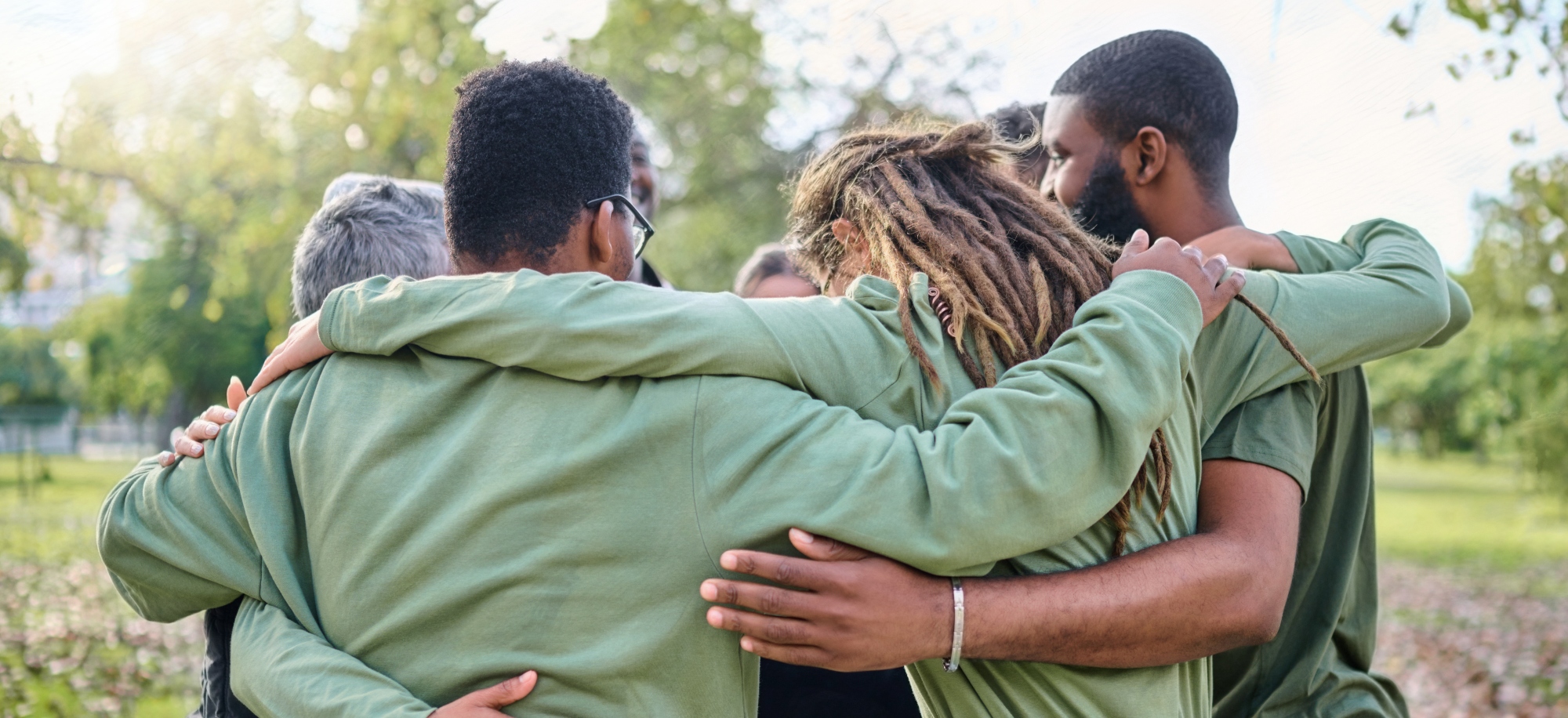
If you are lucky, there are the journeys you take toward other people, toward those who understand, without needing to be told, exactly where you have been.
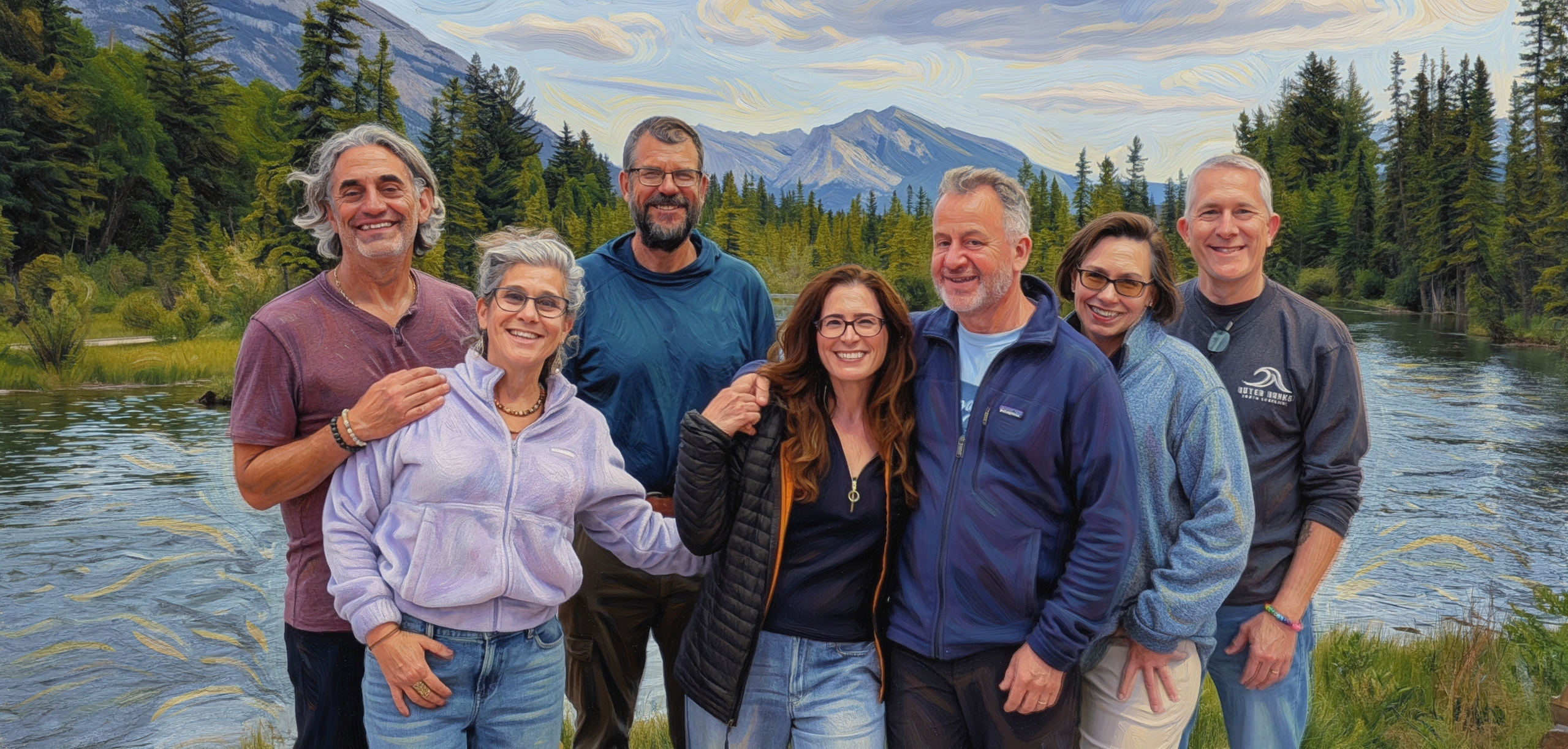
In June 2026, seven parents made exactly that kind of journey — to Banff National Park in the Canadian Rockies. They came from different corners of the United States, but each carried the same thing close to their heart — the name of the child they had lost. Benjamin. Ezra. Max. Nathaniel. Their grief was uniquely their own, but their paths had converged through a shared door: the Alliance of Hope, where a fathers’ grief support group had first brought the men together in early 2025.
That group had begun, as so many grief groups do, with vulnerability and uncertainty. As Eric Fulmer, one of the group’s founding members, put it, they had each experienced “the unimaginable loss of a child to suicide — broken in that way only other suicide loss survivors can truly understand.”
Nine fathers had shown up, some reluctantly, some desperately, to sit with strangers and attempt the nearly impossible task of putting words to that loss. Over eight facilitated sessions, and then months of continued meetings on their own, something unexpected had grown among them: trust, friendship, and something that resembled, however tentatively, hope. The idea of Banff emerged from that foundation. They would find a place of natural grandeur, bring their spouses, and meet — really meet — in person. They would cook together, hike together, and do the one thing that suicide loss survivors rarely get to do freely: talk about their children.
Getting there, for many of them, required more than booking flights. It required courage.
They needed the kind of courage that grief demands when you are asked to step toward something unfamiliar rather than away from it. Peter Ellis, who had been among the trip’s most enthusiastic advocates, found himself growing anxious as the departure date approached. “Would we lead each other into a deep depression hole,” he wondered, “would everyone’s understandable wounds become exacerbated by the differences inevitable within any group?” He worried most about his wife Nanci, who would be walking into a house full of people she barely knew. As a hedge against his own uncertainty, he built a detailed daily schedule — discussion times, proposed topics, structured activities. It was, he later admitted with some affection for his own anxiety, “maybe a little bit crazy complicated and overdone.”
Nanci had her own negotiations to make with herself. When Peter first proposed the trip, she agreed, but cautiously, “preplanning what to do if I got overwhelmed, or annoyed, or just plain regretted agreeing to bunk with five strangers at an Airbnb.” She had lost her son Benjamin just a year and a half earlier. The wound was still raw, and the prospect of being surrounded by other people’s grief, on top of her own, felt like a genuine risk.
Jim Mancini and his wife arrived carrying what he described simply as “excitement and substantial anxiety.” More than five years had passed since they lost their sixteen-year-old son Ezra, and still the idea of four days with near-strangers — people whose only common ground was catastrophic loss — felt daunting. His wife had been unsure whether she wanted to go at all.
This, too, is part of the grief journey: the courage it takes to show up. To pack a bag, board a plane, and walk through a door when you are not sure what waits on the other side.
What waited on the other side was something none of them had expected.
Peter’s elaborate schedule went untouched. It turned out they didn’t need it. From the moment the group gathered, conversation moved naturally and freely toward the very things they had come to talk about — their children, their pain, the texture of their daily lives in the aftermath of loss. “It was a relief,” Jim wrote, “to be able to speak about Ezra for more than a sentence or two without others changing the topic or looking uncomfortable about what to say.”
This is a particular and painful feature of suicide loss: the silence that so often surrounds it. Friends and family, however loving, frequently don’t know what to say — and so they say nothing, or change the subject, or suggest, as one group member’s sister-in-law had, that perhaps it was time to be done being sad. In Banff, none of that existed. “It’s easier when everyone ‘gets it,'” Nanci observed. And when that same sister-in-law story was told at the dinner table, the room didn’t go quietly. It erupted in the kind of laughter that only people who truly understand can share.
That laughter surprised them all, and it became one of the trip’s quiet revelations. Peter described how a joke would surface in the middle of a deeply serious conversation, “and we would all burst out laughing, long and deep, and then we’d take a breath and go back to telling our story, and it was completely normal and accepted.” The group’s innate understanding of profound grief offered a shared place of comfort. A place where levity embraced loss and celebrated meaning. The recognition felt like a small but significant step forward on the journey.
The mountains held them as they moved through all of it.
Erika Fulmer had tracked the weather obsessively in the days before the trip, bracing for five straight days of rain. What she found instead was something more complex — and, she realized, more true. There were bouts of rain, yes, but also piercing blue skies, misty mornings giving way to sun streaming through clouds onto snow-covered peaks. Standing in that ever-changing landscape, she found herself thinking about grief. It moved the same way, she realized “months of despair punctuated by moments of levity, anger, understanding, rage, and purpose” — following the same capricious, ungovernable logic as the sky above her. Erika saw that every grief journey has its own weather. You can monitor the forecast obsessively, bracing for the worst. But the sky will do what it does. And sometimes, when you least expect it, the clouds part.
They hiked long trails and touched cold mountain streams. They cooked meals connected to their children. Jim and his wife prepared Ezra’s favorite dinner for the group on the final night. They made watercolor paintings and crafted small boats carrying messages to their lost children, releasing them into a river in a quiet ceremony of letting go. They spread ashes. They placed photographs of their children along the shelf beneath the fireplace and sat with those images each evening as they talked, and cried, and sometimes laughed again.
Through all of it, the children were present, not as absence, but as presence.
Erika described feeling each child distinctly: “Sweet, introspective Benjamin; audacious, creative Ezra; contemplative, independent Max, and joyful, empathetic Nathaniel. They were there with us.” The meals, the music, the watercolors, the hikes — each became a way of carrying their children forward along the journey, of refusing to let them be reduced to the manner of their deaths.—
No one came home cured. That bears saying plainly, because one of the most important gifts these parents offer is their honesty.
Nanci wrote with characteristic directness: “I want to say that I came home refreshed and uplifted and strengthened for the journey ahead. But what I came home to was a life where my son was still gone. I was shocked by how painful that was.” And yet, in the same breath, she recognized something else — that she had felt better in Banff than she had realized, and that the contrast made the value of that togetherness impossible to deny. The journey had not ended. But she could see it more clearly now.
Peter returned still carrying the full weight of his grief. “I feel just as sad today. I still grieve my son,” he wrote. But something had shifted. He had spent four days in the presence of other parents who had loved their children completely and had still lost them — good people, he kept thinking, people of deep value who had been “beat by something beyond their power.” If he could look at them with love and without judgment, perhaps he could begin to extend that same grace toward himself. That, too, is part of the journey — learning, slowly, to treat yourself as kindly as you would treat a fellow traveler.
Jim came home with something he hadn’t fully anticipated. “It helped me get out of my own head,” he wrote, “to recognize I am not alone in this experience.” After five years of grief that had sometimes felt entirely, crushingly singular, Banff had shown him its edges — shown him that while grief is deeply personal, it need not always be solitary. Other people were making this same hard journey. And knowing that changed something.—
The grief journey does not end.
Anyone who travels it knows that. There is no arrival point at which the loss becomes acceptable or the love stops aching. But the journey changes shape depending on who walks it with you.
Eric Fulmer, reflecting on everything that had grown from those first uncertain meetings, captured it simply: “What began as tragedy beyond words has grown into relationships that carry meaning no words could fully capture.” Through community, he wrote, “there is tremendous power to change lives.”
What these seven parents found in Banff was not a cure and not a conclusion. It was something quieter and more durable: the knowledge that they were seen, that their children were remembered, and that the road ahead — however long and however hard — did not have to be walked alone.
They have already begun planning the next trip.